























India-UAE: An Era of Cross-Border Investment Opportunities for NRIs and Retail Investors
In periods of global economic uncertainty, investors naturally tend to adopt a more conservative approach, prioritising capital preservation over growth. This behaviour is particularly evident among Resident Indian (RI) investors considering UAE markets, as well as NRIs and retail investors in the UAE, who often prefer holding higher cash allocations during volatile phases.
While this approach provides short-term comfort, it may also lead to missed opportunities in economies that continue to demonstrate structural, long-term growth potential.
Historically, wealth creation has not come from timing the market, but from time spent in the market with disciplined, diversified investing.
In this context, the India-UAE Comprehensive Economic Partnership Agreement (CEPA) represents a significant structural shift in bilateral economic relations, with meaningful implications for investors across both geographies.
India–UAE Investment Landscape: Before and After CEPA
Before CEPA (Pre-2022 Era)
Prior to the agreement, India-UAE investment flows were already strong but largely driven by traditional sectors and limited integration:
- UAE investments in India were primarily concentrated in real estate, energy, and sovereign-linked capital
- Indian investments in the UAE were focused on trading businesses, SMEs, and select service sectors
- Cross-border participation in capital markets remained relatively limited
- Regulatory frameworks, while stable, lacked a unified structure to accelerate trade and investment expansion
- Investment decisions were often influenced by bilateral trade frictions, higher transaction costs, and slower market access
Key scale indicators (pre-CEPA estimates):
- Bilateral trade: ~USD 60 - 65 billion annually
- UAE FDI into India: ~USD 11-12 billion cumulative stock
- India-UAE trade growth rate: ~4-6% CAGR (2015-2021 period)
- Despite strong cultural and economic ties, the investment relationship was transactional rather than deeply integrated.
After CEPA (Post-2022 to 2026 and beyond)
Since the implementation of CEPA, the investment ecosystem between India and the UAE has undergone a structural transformation:
- Reduced trade barriers and improved market access across multiple sectors
- Increased participation of UAE-based capital in Indian infrastructure, fintech, and manufacturing
- Strengthened collaboration in financial services, logistics, renewable energy, and technology
- Enhanced investor confidence due to a more predictable and transparent trade framework
- Expansion of cross-border wealth management and financial product distribution channels
Key growth indicators (post-CEPA trajectory):
- Bilateral trade surged to approximately USD 85-100+ billion (2023-2025 range)
- Target trajectory: USD 100-115 billion+ in the near term
- UAE FDI inflows into India increased by an estimated 20-30% acceleration post-CEPA implementation
- India–UAE non-oil trade growth: ~10-12% CAGR post-2022 (vs. ~4–6% earlier period)
CEPA has effectively shifted the relationship from bilateral trade cooperation to strategic investment partnership.
Why This Matters for Retail Investors Today
For retail investors, the key shift is not just macroeconomic, it is structural.
The India–UAE corridor is increasingly becoming a two-way investment bridge, offering:
- Access to one of the fastest-growing emerging markets (India)
- Exposure to a globally connected, capital-rich economy (UAE)
- Greater diversification across currencies, sectors, and asset classes
- Improved ease of doing business and cross-border capital movement
From a wealth creation perspective, even a modest 1-2% improvement in long-term annualized growth rates, when compounded over time, can significantly enhance portfolio outcomes.
In such an environment, remaining entirely on the sidelines or holding excessive idle cash may result in meaningful opportunity cost over the long term.
Investment Avenues for Retail Investors
A well-structured investment approach across both markets can include the following instruments:
1. Mutual Funds
Mutual funds offer investors an efficient way to participate in the growing economic relationship between India and the UAE. As trade, investment, and business collaboration between the two countries continue to expand, mutual funds provide exposure to companies and sectors that are expected to benefit from this partnership. Investing through mutual funds enables investors to participate in this long-term growth while benefiting from professional fund management and a diversified portfolio.
2. Insurance Products
Insurance is an essential part of financial planning for individuals and families with financial interests in both India and the UAE. It provides financial security against unforeseen events while ensuring long-term financial stability. As cross-border employment, business, and investments between the two countries continue to grow, insurance solutions help safeguard income, assets, and future financial goals, allowing investors to build wealth with greater confidence.
3. Fixed Income Instruments
Fixed income investments offer stability and predictable returns, making them an important component of portfolios with exposure to India and the UAE. They offer capital protection and stable returns, making them an ideal choice for investors seeking consistency in their portfolios. As investment opportunities between India and the UAE continue to expand, fixed income instruments provide a dependable foundation for achieving long-term financial goals while reducing overall portfolio risk.
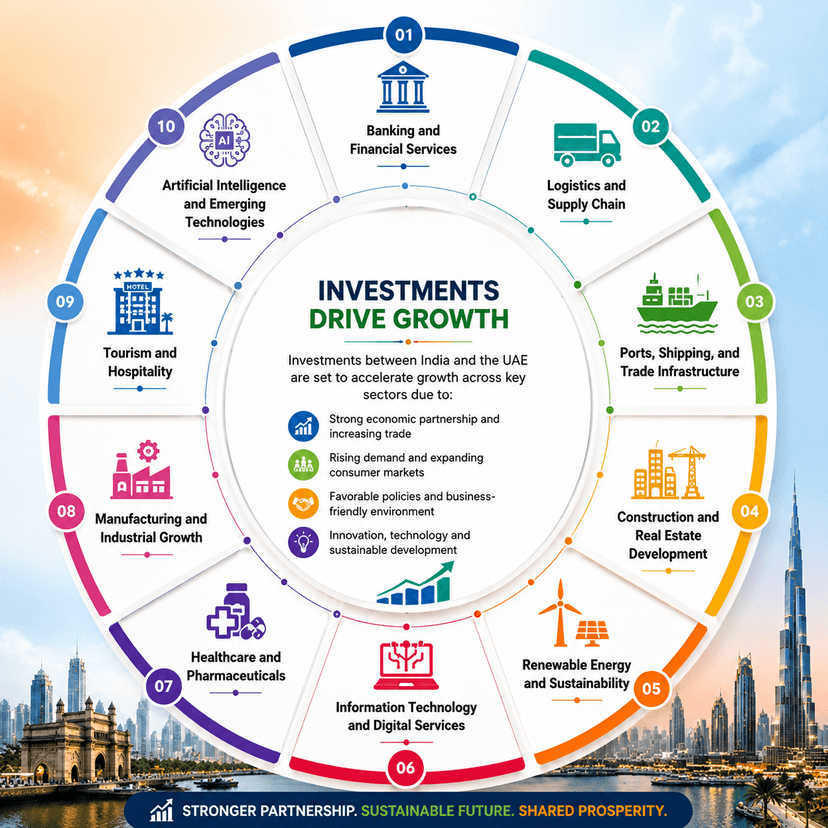
Sectors Positioned to Benefit from CEPA
Key Considerations for Investors
While macroeconomic uncertainty, geopolitical developments and currency fluctuations will continue to influence short-term market movements, they should not overshadow long-term investment strategy.
Successful investing is built on:
- Consistent and disciplined allocation
- Diversification across geographies and asset classes
- Long-term investment horizon
- Avoiding emotional decision-making during volatility
Conclusion:
The India-UAE, CEPA marks a significant milestone in strengthening economic and investment ties between two highly complementary economies.
The data clearly indicates a transition, from moderate, steady bilateral trade growth in the pre-CEPA era, to a higher-growth, structurally integrated investment corridor post-CEPA.
For NRIs, Resident Indians and UAE-based retail investors, this evolving partnership presents a structured opportunity to participate in cross-border growth through diversified financial instruments and long-term investment strategies.
While short-term uncertainty will always exist, the broader direction of India–UAE economic integration suggests a more connected, opportunity-rich investment landscape ahead.
Each successive arrangements has not only supported growth, it has multiplied its scale and efficiency, reinforcing the long-term trajectory of both economies.
Investors who adopt a disciplined, diversified and long-term approach are likely to be better positioned to benefit from this evolving financial corridor in the years to come.